

When Valgeir Sigurðsson began working with Björk, he was already fascinated by the possibilities of bringing acoustic instruments and electronic sounds together, an interest that would eventually shape much of his career as a producer and composer. Their collaboration gave him the opportunity to explore those ideas on an extraordinary scale, working on records that moved freely between orchestral arrangements, electronic programming and sounds that seemed to belong somewhere between the two.
What he couldn’t have known at the time was that the musicians he would meet through those sessions would eventually become part of a much larger creative community, one that would lead him to establish his own record label, Bedroom Community, and help bring together an unusual collection of artists working across contemporary classical, electronic and experimental music.
At the centre of it all was Greenhouse Studios in Reykjavík, where Valgeir had been developing his own approach to recording and production. Unlike studios built around a particular musical style, Greenhouse became a place where different ideas could comfortably coexist, with composers, singers and electronic musicians working alongside one another and often becoming involved in each other’s projects.
For Valgeir, the distinction between acoustic and electronic music had never seemed particularly important. He was interested in what happened when the two were combined, whether that meant manipulating the sound of an orchestral instrument until it became almost unrecognisable or finding a way for musicians to perform something that had originally been created on a computer.
It was a way of working that suited Björk, whose own music had long been driven by an appetite for unusual sounds and unexpected combinations, and their years of collaboration gave Valgeir the chance to develop ideas that would later find their way into his own compositions.
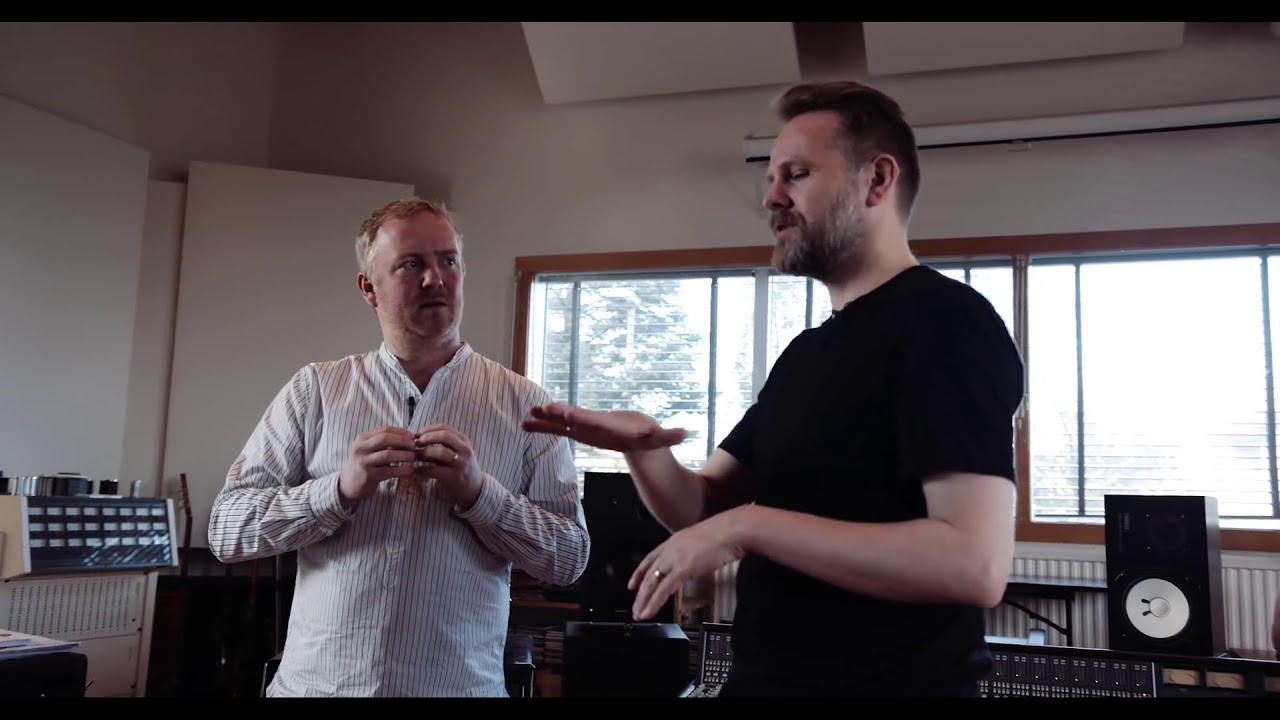
From Björk to Bedroom Community
Although Valgeir had originally been drawn to recording through his interest in writing music, his growing career as an engineer and producer had gradually taken up more and more of his time. He enjoyed working with other artists, often becoming deeply involved in the arrangements and development of their songs, but he was also accumulating musical ideas of his own that rarely found their way beyond the studio.
By around 2004, he began to feel that he needed to make more room for his own work. He had spent years experimenting with sounds, writing fragments of music and exploring different approaches to composition, and increasingly wanted to bring some of the musicians he admired into that process.
At the time, he was dividing much of his working life between Iceland and New York, where Björk was recording parts of her album Medúlla. It was during those sessions that he met the young American composer Nico Muhly, who was studying at Juilliard and working at Philip Glass’s Looking Glass Studios.
The introduction came about almost by accident. Björk needed somebody to play a particularly demanding piano part, and Nico was suggested as someone who might be able to manage it. He arrived, sat down at the piano and played the piece with such ease that Valgeir was immediately impressed.
The two began talking about music, and before long Nico was sending Valgeir recordings of his own compositions, some of which had been made in less than ideal circumstances with microphones placed wherever there happened to be room. The quality of the recordings was hardly the point, however, because the music itself was so interesting that Valgeir immediately began thinking about how it might sound if they were able to record it properly.
He suggested that Nico come to Iceland, where they could work together at Greenhouse Studios and explore the possibilities of developing the compositions into an album.
Around the same time, Valgeir had become close to Australian musician Ben Frost, who had moved to Iceland and was working on music that occupied a very different world from Nico’s. Where Nico’s compositions drew on the traditions of contemporary classical music, Ben was exploring powerful electronic sounds, dense textures and music that could be both beautiful and unsettling.
Valgeir was fascinated by both approaches, and began to imagine what might happen if the three of them worked together, contributing to one another’s projects rather than making separate records.
There was, however, the practical question of how to release the music. Neither Nico nor Ben fitted easily into an established commercial category, and Valgeir wasn’t convinced that a conventional record label would know what to do with their work, however good the recordings might be.
Rather than spend months trying to persuade somebody else to take an interest, he decided to start a label himself.
Creating a musical community
Bedroom Community grew out of that decision, although Valgeir never really imagined it as a traditional record company with a roster of artists who happened to share the same label. What interested him was the possibility of building a musical community in which composers, performers and producers could become involved in each other’s work, bringing their different skills and perspectives to projects that might otherwise have remained entirely separate.
Nico could contribute arrangements to Valgeir’s own compositions, while Ben might introduce electronic elements to somebody else’s music. The musicians were encouraged to exchange ideas and experiment, and the label gave them a way of releasing records without having to worry about whether they fitted comfortably into a recognised genre.
Getting everything started was more complicated than Valgeir had anticipated. He suddenly found himself dealing with manufacturing, distribution, artwork and the countless practical details involved in running a record label, responsibilities that took him away from the studio for several months.
Yet the effort was worthwhile, not least because it gave him something he had been missing in his own career: a group of musicians with whom he could develop his compositions in the same collaborative way that he had spent years helping other artists develop theirs.
The collective gradually expanded to include musicians such as Sam Amidon and Puzzle Muteson, whose work brought further influences into the group. There was no particular house style that everyone was expected to follow, and the records could sound very different from one another, but they shared a willingness to experiment and an interest in the possibilities that emerged when musicians from different backgrounds worked together.
Greenhouse Studios became the natural centre of that activity, a place where projects could develop through conversation, experimentation and the exchange of ideas, often taking directions that nobody had anticipated when the sessions began.
Working with Nico Muhly
Valgeir’s relationship with Nico Muhly became one of the most important of these collaborations, partly because their different approaches to making music complemented one another so well.
Nico was an extraordinarily fast and inventive composer, capable of generating complicated musical ideas with remarkable ease, while Valgeir enjoyed the process of taking those ideas into the studio and finding ways to develop them through recording, editing and electronic manipulation.
One of the most interesting examples was Mother Tongue, a composition that combined conventional musical notation with sounds that could only really exist through the recording process.
Nico had written much of the piece by hand, working out the structure on manuscript paper before bringing it into the studio, where Valgeir helped transfer the material into Pro Tools. From there, they began exploring how the different elements could be arranged and manipulated, gradually turning what had originally been conceived as a continuous composition into a series of movements.
Part of the process involved recording the singer Abby Fischer performing individual letters, numbers and fragments of speech, which were then sampled and organised so that Nico could play them from a keyboard. It was an unusual way of using the human voice, transforming something as familiar as spoken language into an instrument that could be incorporated into a much larger composition.
The technique was complicated, but the real challenge was making the results feel musical rather than simply clever. Nico had no shortage of ideas, and Valgeir’s role often involved finding a way to bring them together without losing the energy and spontaneity that made the original compositions so interesting.
Their working relationship developed around that balance. Nico could continue generating material, knowing that Valgeir would help shape it into a recording, while Valgeir enjoyed the challenge of discovering how the different musical elements might fit together.
It was a partnership in which the distinction between composition and production became increasingly blurred, with decisions made during recording and mixing often having as much influence on the finished music as the original written score.
The extraordinary world of Medúlla
Valgeir had already explored many of these ideas during his work with Björk, particularly on Medúlla, the 2004 album that was created almost entirely from human voices.
The project hadn’t begun with a rigid plan to exclude conventional instruments. Björk had been interested in exploring different vocal techniques and wanted to work with singers whose approaches were very different from her own, including Inuit throat singer Tanya Tagaq, whose extraordinary abilities opened up a new range of possibilities.

As the sessions developed, Björk and Valgeir began experimenting with the idea of replacing instrumental parts with vocal performances, gradually discovering that sounds they would normally have created using synthesisers, drums or other instruments could be reproduced, or at least reimagined, using the human voice.
What began as an experiment slowly became the central idea behind the record.
The sessions took them between Iceland, New York, Brazil and the Canary Islands, recording singers, choirs and performers with very different musical backgrounds. Artists including Mike Patton and beatboxer Rahzel became involved, while choral recordings made in Iceland provided another layer of sound.
The challenge was bringing all these different voices together into arrangements that felt coherent, particularly when some of the performances had been recorded in very different acoustic environments.
A closely recorded vocal might need to sit alongside a choir captured in a large room, while a heavily processed beatbox performance had to work within the same musical arrangement as a delicate melodic line. Valgeir spent considerable time experimenting with the sense of space around each sound, sometimes recording voices at different distances from the microphone or creating artificial environments afterwards.
There were also practical problems to overcome. Human voices don’t naturally produce the same range of sounds as conventional instruments, and finding ways to recreate the weight and impact of a bass line, for example, required considerable experimentation.
Rather than treating the recordings as purely acoustic performances, Valgeir used sampling, editing and electronic processing to transform them into sounds that could function as rhythm instruments, bass parts or atmospheric textures.
The finished album was therefore both entirely human and heavily technological, combining the physical character of the voice with the possibilities offered by electronic production.
For Valgeir, this was part of what made the project so exciting. The limitations imposed by the concept forced everyone involved to think differently, and some of the most interesting sounds emerged from attempts to solve problems that would never have arisen on a more conventional recording.
It was also a reminder of how much could happen when musicians were willing to follow an idea without knowing exactly where it would lead.
Making music without boundaries
What connects Valgeir’s work with Björk, Nico Muhly, Ben Frost and the other musicians associated with Bedroom Community is his willingness to let the recording process become part of the creative process itself.
Rather than approaching a project with a fixed idea of how it should sound, he enjoys exploring what might happen when musicians and technology interact in unexpected ways, whether that means translating an electronic sequence into an acoustic performance or taking a recording of a conventional instrument and transforming it into something entirely different.
His experience as a composer has undoubtedly influenced the way he works as a producer, just as the years he spent producing other people’s music have shaped his own compositions. The two activities have become closely connected, with ideas moving freely between them and the studio providing a place where those ideas can be explored.
Bedroom Community gave him the opportunity to take that approach further, surrounding himself with musicians who were equally interested in experimentation and who could contribute to his work as readily as he contributed to theirs.
There is something particularly appealing about the way Valgeir has built his career around these relationships. Rather than concentrating exclusively on the opportunities that came from his work with Björk, he used the experience and connections he had developed to create a musical world of his own, one that has continued to attract artists whose work doesn’t fit neatly into established categories.
The records that have emerged from Greenhouse Studios and Bedroom Community reflect that openness, moving between contemporary classical composition, electronic music, experimental songwriting and film music without feeling constrained by any one of them.
For Valgeir, the pleasure of making records has always seemed to lie as much in the process of discovery as in the finished recording, whether that means finding an unexpected sound, solving a complicated musical problem or bringing together musicians who might never otherwise have worked in the same room.
And perhaps that is what makes his career particularly interesting. Alongside the records he has produced and the music he has composed, he has created a community in which other artists have been able to explore their own ideas, and where collaboration has become as important as the individual projects themselves.
About Valgeir Sigurðsson
Valgeir Sigurðsson is an Icelandic record producer, composer, musician and recording engineer whose work spans experimental pop, electronic music, contemporary classical composition and film music.
He is particularly well known for his creative relationship with Björk, including work on albums such as Vespertine and Medúlla, as well as collaborations with artists and composers including Nico Muhly, Ben Frost and Sam Amidon.
Based in Reykjavík, Valgeir founded Greenhouse Studios and established the Bedroom Community record label, creating an internationally recognised platform for adventurous music that crosses traditional genre boundaries.
His work as a producer and composer frequently combines acoustic instruments with electronic manipulation, using the recording studio as an important part of the composition and arrangement process.
Valgeir Sigurðsson is represented by Stephen Budd Music. For production enquiries and further information, visit Record-Producers.com.
Frequently Asked Questions
Who is Valgeir Sigurðsson?
Valgeir Sigurðsson is an Icelandic record producer, composer, musician and recording engineer best known for his work with Björk and for founding Bedroom Community, a Reykjavík-based record label and creative collective.
Which Björk albums did Valgeir Sigurðsson work on?
Valgeir worked with Björk on several projects, including Vespertine and Medúlla. His contributions have included recording, programming and developing arrangements that combine electronic production with acoustic instruments and voices.
What is Bedroom Community?
Bedroom Community is an Icelandic record label and creative collective founded by Valgeir Sigurðsson. Its artists have included Nico Muhly, Ben Frost, Sam Amidon and Puzzle Muteson, and the label is known for music that crosses the boundaries between contemporary classical, electronic and experimental genres.
Where is Greenhouse Studios?
Greenhouse Studios is located in Reykjavík, Iceland. Founded by Valgeir Sigurðsson, it has been an important recording and creative centre for his work and for artists associated with Bedroom Community.
How was Björk’s Medúlla recorded?
Medúlla was created almost entirely from human voices, using singers, choirs, beatboxers and experimental vocal performers. Valgeir worked with Björk to develop arrangements in which vocal recordings were edited, sampled and electronically processed to replace many conventional instrumental sounds.
Who has Valgeir Sigurðsson worked with?
Valgeir Sigurðsson has collaborated with Björk, Nico Muhly, Ben Frost, Sam Amidon and other artists across experimental pop, contemporary classical and electronic music.
How can I contact Valgeir Sigurðsson for record production?
Valgeir Sigurðsson is represented by Stephen Budd Music. Enquiries about his availability for record production can be made through Record-Producers.com.